On the map, the Gobi appears as a vast pale expanse covering southern Mongolia. It seems as though several days among the sands would quickly begin to feel repetitive. In reality, the opposite happens.
The farther the road leads away from the familiar grasslands, the more it feels as though the landscape follows its own rules. Here, it is easy to spend an entire day driving without ever guessing what lies beyond the next horizon.
Perhaps that is why a journey through the Gobi is rarely remembered simply as a trip to a desert. It feels more like traveling through several completely different worlds united under a single name.
The Singing Dunes of Khongoryn Els
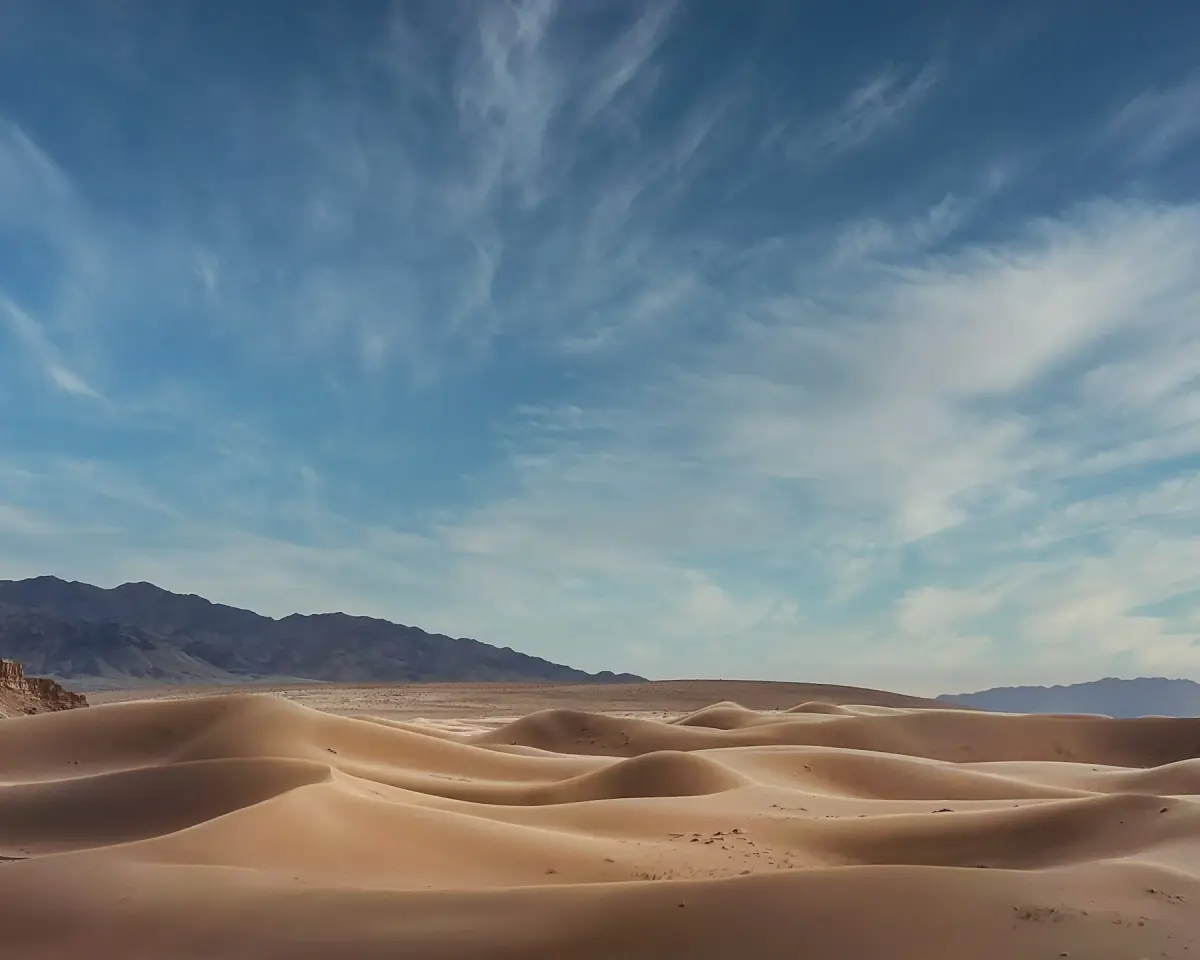
If there is one place that best captures the scale of the Gobi, it is the dunes of Khongoryn Els. Some rise more than 200 meters high, while the dune system itself stretches for nearly one hundred kilometers.
Climbing the dunes does not require any special training, but it is far from an effortless walk. The loose sand makes every step more demanding than it appears from below. Depending on your pace and physical condition, the ascent usually takes between thirty minutes and an hour.
Most travelers complete the climb without difficulty if they take their time and pause occasionally. The challenge is greater on hot days or for those who are not used to walking on uneven terrain.
The reward is a view that draws visitors from across Mongolia. From the top, dune ridges stretch toward the horizon, while green valleys and distant mountain ranges appear unexpectedly at their base. The scene is particularly beautiful at sunset, when the sand turns golden and long shadows reveal every contour of the landscape.
Yolyn Am Ice Canyon
One of the most surprising stops in the Gobi.
After several days among dry landscapes, it is hard to believe that a deep canyon with cool air and towering rock walls awaits ahead.
The road passes through Gobi Gurvansaikhan National Park. As you approach, the cliffs grow higher and the valley becomes narrower. Even in summer, the canyon feels noticeably cooler, and walking through it reveals a completely different side of the Gobi.
The Flaming Cliffs of Bayanzag
The red cliffs of Bayanzag are at their most beautiful in the evening light. It is then that their nickname, the Flaming Cliffs, makes perfect sense.
The site is famous not only for its scenery. It was here that some of the world’s first dinosaur egg fossils were discovered, bringing international attention to the region. Today, visitors come for the striking landscapes and the feeling that time moves differently here.
Nomads and Camels of the Gobi
A journey through the desert would be incomplete without meeting the people who call it home.
For centuries, communities have adapted to life in these harsh conditions, developing a way of life closely tied to nature.
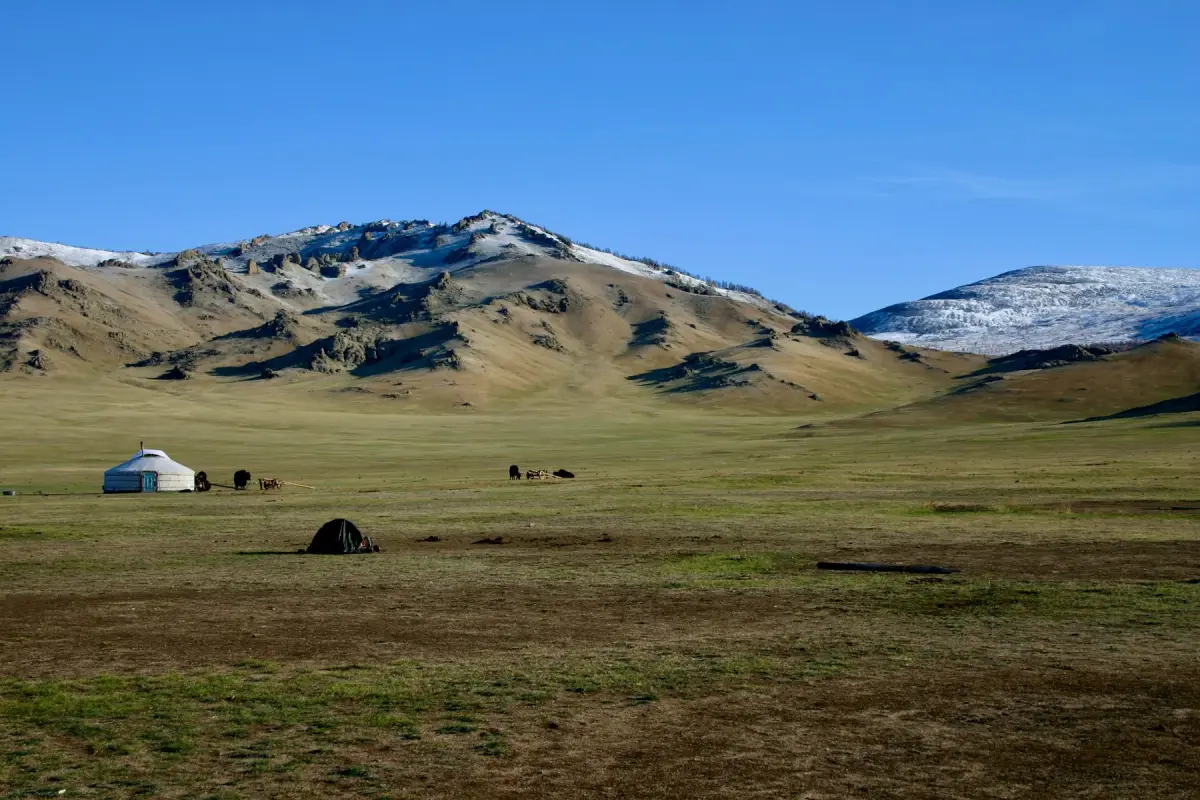
Along the road, it is common to encounter herds of Bactrian camels, nomadic camps, and solitary yurts standing in the middle of vast open landscapes. Spending a few hours with a local family often provides a deeper understanding of the region than any guidebook ever could.
The Night Sky
Some attractions are meant to be photographed.
Others are experiences that no photograph can fully capture.
One of them is the night sky of the Gobi. After sunset, silence settles across the landscape. The lights of cities remain far away, and thousands of stars appear overhead. In moments like these, the immense scale of the desert becomes impossible to ignore.
Suggested Route
The adventure begins with the drive into southern Mongolia. Gradually, the familiar grasslands begin to change. Vegetation becomes scarcer, and the landscape feels increasingly vast. Along the way, you can stop at nomadic settlements, observe herds of horses and camels, and begin adjusting to the rhythm of the journey.
By evening, arrive in the area surrounding Gobi Gurvansaikhan National Park and spend the night near the mountains.
In the morning, head to one of the region’s most unusual places. Narrow passages, towering cliffs, and cool air create the impression that the desert has been left far behind.
After exploring the canyon, climb to one of the viewpoints within the national park and watch the sunset over the mountains of the South Gobi.
After breakfast, travel to the famous red cliffs. The road crosses open landscapes where settlements are few and far between.
As evening approaches, the cliffs begin to glow beneath the setting sun. This is when Bayanzag is at its most spectacular. Spend the night near the cliffs.
Today brings one of Mongolia’s most iconic landscapes. Long before you arrive, the enormous dunes become visible on the horizon.
In the afternoon, climb one of the ridges. The ascent is longer than it appears from below, but the view from the top fully justifies the effort. End the day watching the sunset from among the sands.
Dedicate this day to experiencing everyday life in the region. Visit nomadic families, observe camels, try traditional tea, and spend time away from the main tourist routes.
The Gobi reveals itself best during these slower days, when there is nowhere you need to rush.
Wake early and return to the dunes or simply watch the sunrise across the open landscape. Light changes constantly in the desert, and the early morning often feels just as magical as sunset.
After breakfast, continue your journey through Mongolia or return to Ulaanbaatar, carrying memories of a region far more diverse than you could have imagined before arriving.