When people talk about New Zealand’s South Island, they usually think of its lakes, mountains, and fjords. Yet almost everyone who has been here remembers more than just the destinations. They remember the roads that lead to them. This is where a journey becomes more than simply travelling between attractions. Around every bend, the light changes, new peaks appear, forests disappear, golden hills emerge, and the landscape transforms completely. That is why so many people consider the South Island one of the world’s greatest road trips—not only because of its spectacular scenery, but because the roads themselves become part of the experience.
Why the South Island Is Best Explored by Car
A car here is more than just a convenient way to get around. It gives you the freedom to stop where a bus never would—at an unnamed viewpoint, beside a perfect mountain reflection, or wherever an unexpected scene turns into the highlight of your day. That freedom is what makes the journey itself just as memorable as the places it leads to.
SH80 — The Road That Slowly Brings You Closer to New Zealand’s Highest Mountain
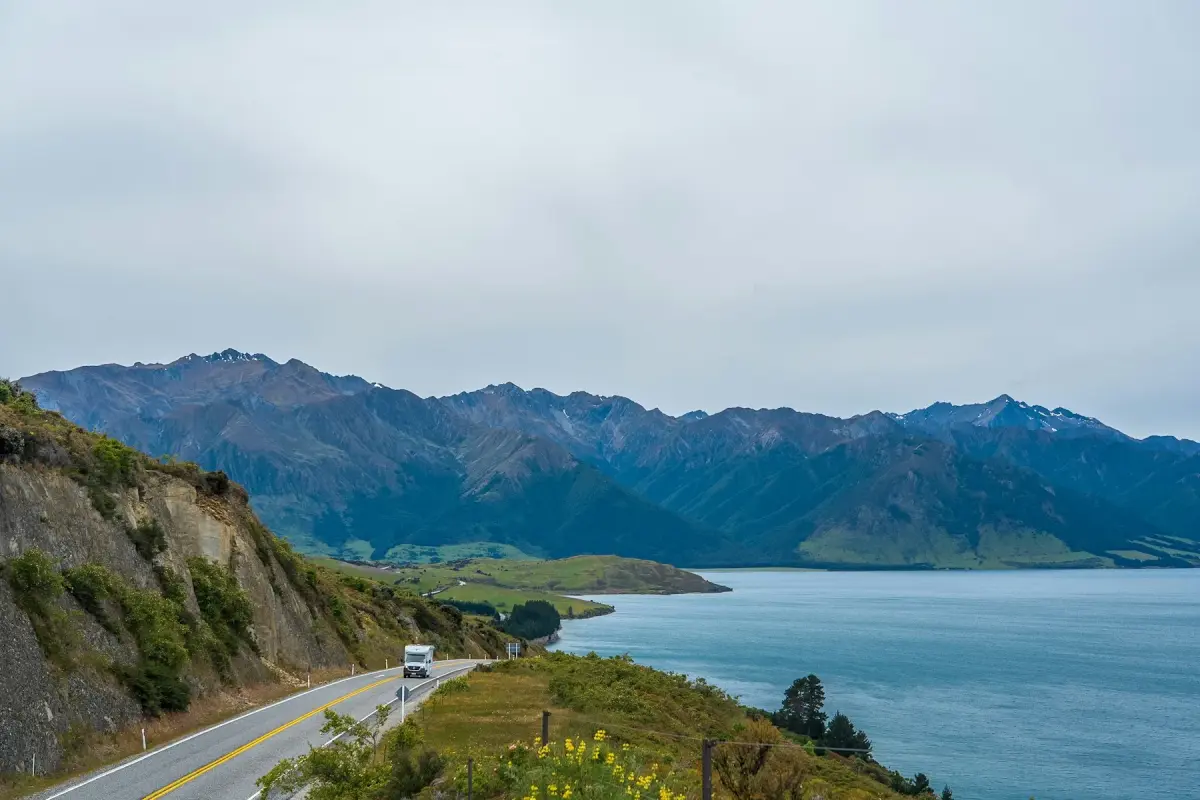
Some roads simply end at a beautiful destination. SH80 is different: it becomes more beautiful with every kilometre. For nearly 60 kilometres, you drive toward Aoraki / Mount Cook, New Zealand’s highest mountain, yet it hardly seems to get any closer. It remains on the horizon while the brilliant turquoise waters of Lake Pukaki stretch between you and the summit.
That is what creates its extraordinary sense of scale. The lake grows wider, the mountains become taller, and Aoraki slowly rises above the horizon. On a clear day, the water looks almost unreal, its vivid blue colour created by fine glacial silt suspended in the lake. It feels less like driving along a road and more like gradually entering a photograph you’ve only ever seen on postcards.
It’s almost impossible to make just one stop along the way. Peter’s Lookout offers one of the South Island’s most iconic views of Lake Pukaki and Aoraki, while a little farther on, short walks lead to Kea Point and the Tasman Glacier View. Even if you had planned to stay in the car, this road keeps finding reasons for you to step outside.
The beauty of SH80 lies in its patience. It reveals nothing all at once. Every kilometre becomes slightly more dramatic than the last, so by the time you arrive in Aoraki / Mount Cook National Park, the journey toward the mountain feels every bit as unforgettable as finally standing beneath it.
Lindis Pass — A Road That Looks Nothing Like the New Zealand You Expected
After turquoise glacial lakes and snow-covered peaks, it’s easy to assume the South Island will look the same for the rest of your journey. Lindis Pass completely overturns that expectation.
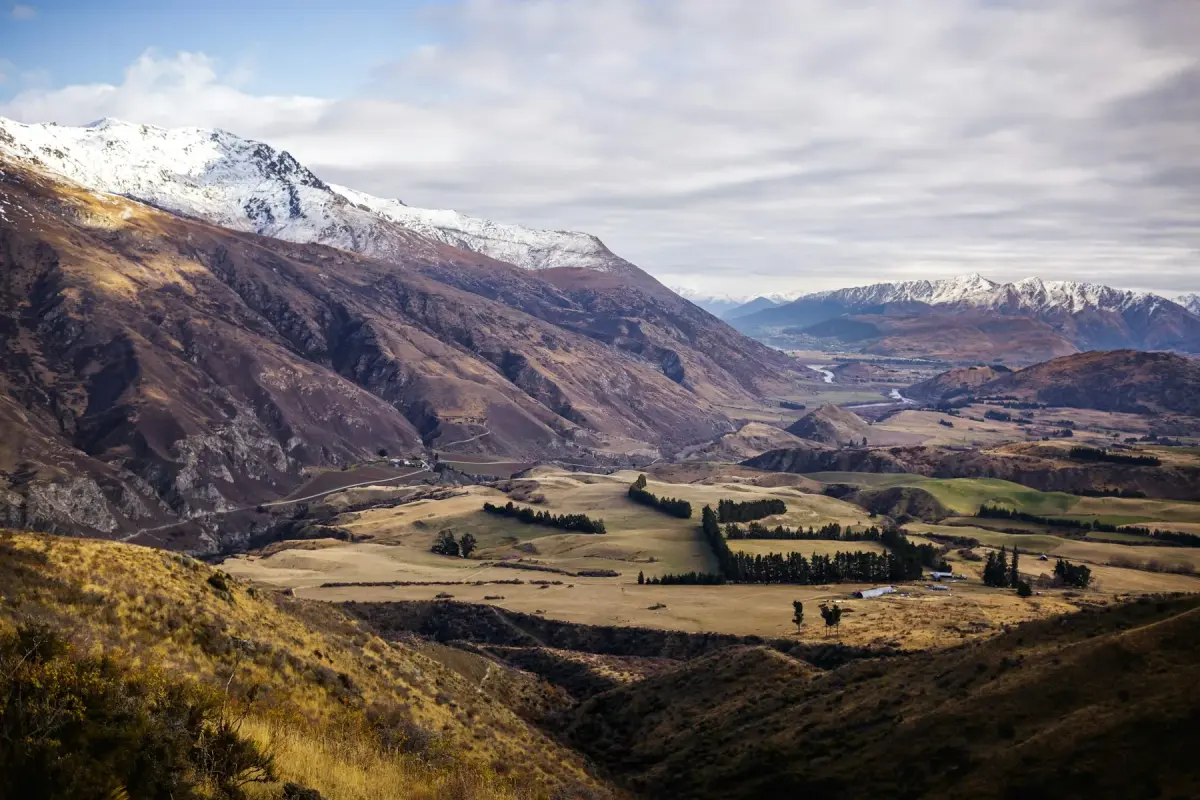
The scenery suddenly becomes dry and almost treeless. Dense forests give way to rolling golden hills covered in tussock grass, while the road climbs gently toward the mountain pass through an immense open landscape. Many travellers compare it to the American West or the high plateaus of Central Asia, with only occasional reminders that you’re still in New Zealand.
The beauty of Lindis Pass has an entirely different character. There are no glaciers, dramatic cliffs, or brilliantly turquoise lakes here. Instead, you’ll find soft rolling hills, an extraordinary sense of openness, and constantly changing light that transforms the landscape throughout the day. It is especially beautiful in the early morning and late afternoon, when the dry grass glows deep gold beneath the low sun.
Lindis Pass is remarkable because it delivers the first great contrast of the journey. Within just a few hours, the island reveals an entirely different personality, making you realise just how diverse the South Island truly is.
Crown Range — New Zealand’s Highest Sealed Mountain Road
Most roads avoid mountains. Crown Range drives straight through them.
The climb begins gently before turning into a series of winding switchbacks that gradually lead to New Zealand’s highest sealed mountain pass. With every metre of elevation, wider views open across valleys, lakes, and surrounding mountain ranges. On a clear day, you’ll find yourself stopping again and again—not because you have to, but because every corner reveals a new view.
At the summit lies one of the South Island’s best-known lookouts, overlooking Central Otago—a landscape completely different from the Mount Cook region. Here, rugged alpine scenery gives way to broad valleys, vineyards, and softly rolling hills.
Crown Range is memorable for more than its panoramic views. It allows you to feel the island changing around you. In a surprisingly short distance, the elevation, temperature, vegetation, and even the mood of the landscape all shift dramatically. That is why this road feels like a destination in its own right, rather than simply the route between two towns.
Glenorchy Road — Forty-Five Minutes That Almost Nobody Drives Without Stopping
The drive from Queenstown to Glenorchy is short. Without stopping, it takes less than an hour. Almost nobody drives it that way.
For nearly the entire journey, the road follows the shoreline of Lake Wakatipu, whose scenery constantly changes. At times the water reaches almost to the edge of the road; elsewhere long pebble beaches appear, followed by dense beech forests and steep mountain slopes. It feels as though the lake deliberately reveals a different side of itself every few minutes.
The best-known stop is Bennett’s Bluff Lookout, where the unusual shape of Lake Wakatipu and the mountains rising almost directly from the water become impossible to forget. Yet the beauty of this drive isn’t concentrated in one place. Small pull-offs appear throughout the route, inviting you to stop for a few minutes—only to discover what may become your favourite view of the entire trip.
As Glenorchy approaches, the landscape becomes increasingly wild. The forests grow denser, the mountains rise higher, and signs of civilisation gradually disappear. That is why this road has become one of New Zealand’s most cinematic drives. It has appeared in The Lord of the Rings, The Hobbit, and many other films, but even without that connection, it feels like a place that has remained almost unchanged for thousands of years.
Milford Road — The Road That Prepares You for the Fjord
Most roads simply lead to a beautiful destination. Milford Road gradually explains why Milford Sound exists at all.
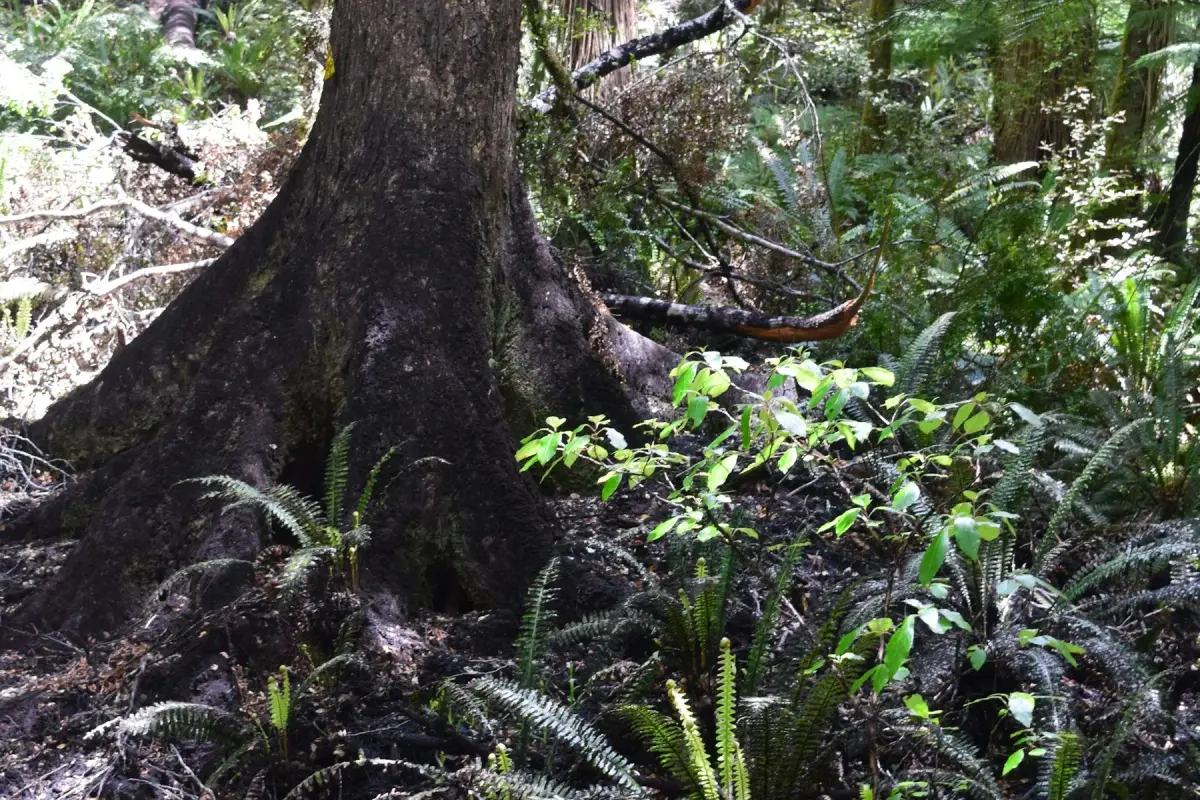
The journey begins among peaceful farmland near Te Anau before entering dense rainforest, passing towering granite cliffs, mountain rivers, and increasingly dramatic peaks. The farther you drive, the less familiar the world begins to feel. After rainfall, dozens of temporary waterfalls cascade down the cliffs at once, transforming the landscape almost beyond recognition.
Its signature stops are impossible to confuse with anywhere else. Mirror Lakes reflects the surrounding mountains almost perfectly. The Eglinton Valley impresses with its immense scale. At The Chasm, thousands of years of rushing water have sculpted smooth, flowing rock formations that seem almost impossible to believe. Then, almost unexpectedly, the road disappears into Homer Tunnel, carved directly through solid granite.
Many travellers say Milford Sound itself was the highlight of their journey. But just as many later realise something unexpected: the drive to the fjord was almost every bit as unforgettable as the destination itself.
Roads Worth Coming Back For
After a journey like this, you realise that your strongest memories aren’t only of turquoise lakes, snow-covered peaks, or famous fjords. They are the kilometres between them: the morning light over Lake Pukaki, the golden hills of Lindis Pass, the switchbacks of Crown Range, the curves of Lake Wakatipu, and the waterfalls lining Milford Road.
That is why so many people return to the South Island. Not because they missed a famous attraction, but because they want to drive these remarkable roads one more time.